
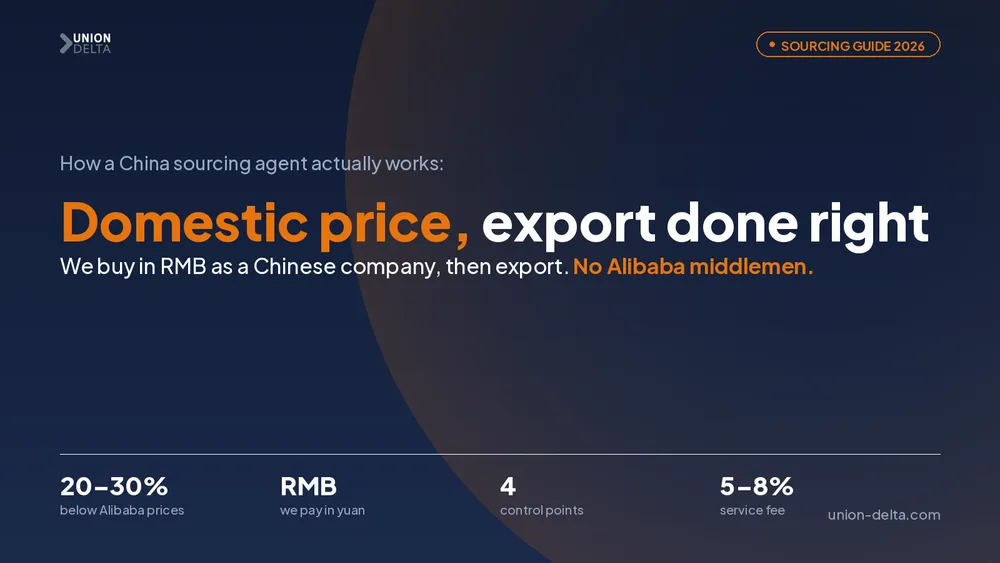
Alibaba is China's export shop window. Behind it is a much larger domestic market where the same factories sell the same products in RMB, at domestic prices, to Chinese buyers. That market is where we buy. Union Delta purchases as a Chinese company, pays the factory in yuan, takes the goods into our own warehouse in Guangzhou, and only then exports them to the USA under proper documents. This guide explains why that produces lower prices than Alibaba or an FOB quote, what makes the domestic market hard to work in, what we actually do between your spec sheet and your warehouse, and what the 5–8% fee covers.
Two prices for the same product: domestic and export
Every Chinese factory that exports has two price lists. The domestic one is in RMB, quoted ex-works, for buyers who collect the goods inside China and pay from a Chinese bank account. The export one is in US dollars, quoted FOB a Chinese port, for foreign buyers. The gap between them is usually 20–30% for the same product from the same line, and it is not greed. An FOB price has to carry costs that a domestic sale does not.
| Cost or risk | Domestic sale in RMB | FOB export sale in USD |
|---|---|---|
| Export licence, customs declaration, export documents | Not needed; the buyer collects domestically | The factory needs its own export licence or has to route the sale through a trading company, and prices that in |
| VAT handling | Standard domestic invoice terms | Export VAT rebate paperwork, cash tied up for months, often done by an intermediary for a fee |
| Currency | RMB, no exchange risk for the factory | USD; the factory hedges by rounding the price up |
| Export packaging and inland transport to port | Basic cartons, pick-up at the factory gate | Export cartons, palletising, trucking to Shenzhen, Ningbo or Shanghai |
| Communication and platform costs | WeChat, Mandarin, no platform fees | English-speaking sales staff, Alibaba membership, Trade Assurance fees |
| Small foreign order | A normal order | A low-priority order that ties up the export department for a container-load of paperwork |
This is the first thing we tell clients who ask for "FOB prices": the moment a factory quotes FOB, it stops quoting as a factory and starts quoting as an exporter, and the price goes up. Our model avoids that step. We buy at the domestic price and handle the export side ourselves.
How we buy: as a Chinese company, on the domestic market
- We find the actual factory, not its export front. Many of the best suppliers are not on Alibaba at all, or appear there through a trading company under another name. We work from 1688, industrial clusters, trade fairs and a network of factories we have bought from for years, and we verify each one in person or by video before a quote reaches you.
- We negotiate in RMB, on domestic terms, in Mandarin. The factory is talking to a Chinese buyer with a domestic benchmark in hand, not to a foreign buyer who found them on a platform. See the negotiation section below.
- We sign a Chinese purchase contract, in Chinese, with the factory's company chop, with the quality standard, delivery date, penalties and acceptance procedure written in. That contract is enforceable in a Chinese court; an English purchase order sent from abroad, in practice, is not.
- We pay the factory in yuan from our China-side company. The factory gets what it wants: RMB, on the deposit-and-balance terms it uses with domestic customers.
- We take delivery domestically, at our own warehouse in Guangzhou, where the goods are counted and inspected before the balance is released.
- We export under our own paperwork: commercial invoice, packing list, customs declaration with the right HS codes, certificate of origin where needed, and the compliance documents the US side requires. The factory never has to become an exporter for your order.
Why the domestic market is hard to work in from abroad
Everything above sounds simple until you try to do it from the USA. These are the walls importers hit, and the reason a sourcing agent in China exists as a profession.
- No English, no platform, no buyer protection. 1688 and the factories behind it operate in Chinese only. There is no Trade Assurance, no escrow and no dispute button. Your protection is the contract and the person who signed it on your side.
- Payment is in RMB, and often only to a company account inside China. Domestic suppliers do not take US wires or credit cards. A foreign buyer with no Chinese entity simply cannot pay.
- Domestic shipping only. The factory delivers to a Chinese address. Someone has to receive, check, store and export the goods.
- Invoices and VAT. Domestic quotes come with or without a VAT invoice, and the two prices differ. Exporting legally requires the right paperwork chain; getting it wrong means goods stuck at customs or duties paid twice.
- Subcontracting. A busy factory will quietly pass a small or awkward order to a neighbouring workshop. The sample came from the main line; the production run did not. You only find out if someone is on the floor.
- Supplier psychology. The first price is an opening position, not an insult. "Yes" often means "we will see". The boss decides, not the sales rep you have been messaging. Pushing too hard too early costs you priority when the line is full; not pushing at all costs you 15%. Peak season (before Chinese New Year and in the autumn run-up to US holidays) is when your order slips a month unless someone with a relationship calls.
- Quality drift. Materials get substituted, tolerances relax, packaging changes, and nobody tells you, because from the factory's point of view nothing important changed.
- Legal position. If something goes wrong, a foreign buyer with an English PO and a US bank transfer has almost no leverage. A Chinese buyer with a chopped contract, a domestic payment trail and a warehouse in the same province has all of it.
Negotiation on your behalf
We negotiate as your buyer, not as a messenger. The difference is what is on the table. We arrive with the domestic price for the same or an equivalent product, a quantity ladder (first order, six-month volume, annual estimate), a clear spec so the factory cannot quote the cheapest interpretation, and, in most cases, a history with the factory or its neighbours. Then we work the items that matter, in the order the factory expects:
- Unit price at three quantities, because the factory's real cost breaks show up in the ladder.
- MOQ: set high to filter small buyers, negotiable with a forecast, mixed colours or an agreement on leftover materials.
- Payment terms: deposit and balance, with the balance tied to our inspection, not to the factory's photos.
- Tooling: cost, lead time and ownership in writing when a mould is involved.
- Sample approval and quality standard: the approved sample becomes the reference; the AQL level is named in the contract.
- Delivery date and penalties: a calendar date from the deposit, with consequences for slipping.
Typically there is 10–25% between a factory's first number and the final one. More important than the discount is what the factory gives a buyer it expects to see again: priority on the line, honest lead times, and a call before a problem becomes a delay.
The legal and paperwork side we close
- Purchase contract in Chinese with company chop: specification, quality standard, acceptance procedure, delivery date, penalties, tooling ownership.
- Confidentiality and non-compete terms where the product is yours, written for a Chinese court rather than copied from a US template.
- Compliance documents: test reports and certifications the US market requires for the product category, arranged with the factory or a testing lab before production, not after.
- Export documents: commercial invoice, packing list, customs declaration, HS classification, certificate of origin when needed, and the freight documents for sea, air or express.
- Import side: duty and tariff exposure per SKU checked before you commit, including Section 301 and the current de minimis rules, so the landed cost has no surprises. See our 2026 tariff rates by category.
Control at every stage
Inspection is not one visit at the end. On our orders it is four points, and nothing ships without your approval at the last one.
| When | What we check | What it prevents |
|---|---|---|
| Before production | Materials and components against the spec, the approved sample on the line, tooling first shots | Substituted materials, wrong colour, a mould that never matched the drawing |
| During production | Factory visits, progress photos, checks of early units, confirmation the work is on the factory's own line | Subcontracting, spec drift, a delay discovered on the ship date |
| Pre-shipment | AQL inspection: sampling, measurements, function tests, packaging, labels; full photo and video report | A bad batch reaching your warehouse or Amazon FBA |
| Loading | Carton count, seal, condition, loading supervision at our warehouse or the factory | Short shipments, crushed cartons, the wrong pallet on the truck |
Consolidation and repacking in Guangzhou
Most orders involve more than one supplier: the product from one factory, packaging from another, an accessory from a third. Shipping each separately to the USA is the most expensive way to move goods. Our warehouse in Guangzhou takes delivery from all of them, checks and counts, and builds one shipment.
Repacking is where the freight bill drops. Freight is charged on volume or weight, whichever is greater, and domestic factory cartons are rarely built for that: half-empty boxes, retail overpack inside a master carton, cartons that do not stack on a pallet. We repack into tight export cartons, remove packaging you do not need on the US side, palletise correctly and, for Amazon sellers, do the FBA prep in the same pass: FNSKU labels, polybags, carton labels, shipment plan. The result is fewer cubic metres on the same order, and one DDP shipment to your warehouse or to FBA instead of three. Rates and options are in our shipping from China to the USA guide.
The same model works for whole product categories. For AI teams buying GPU servers, 4U chassis, power kits and spare parts, we wrote up the numbers separately in AI Server Hardware from China.
What it costs
The service fee is a percentage of the order, agreed before the order is placed. There is no margin hidden in the product price.
| Service | Price |
|---|---|
| Sourcing request: 3–5 verified factories, quotes, MOQs and lead times within 24 hours | Free |
| Samples | $20 per piece + actual courier cost |
| Full service: domestic purchasing, negotiation, contract, production control, four-point inspection, consolidation, export documents, FBA prep | 5–8% of the order value |
| Large orders | Negotiated; lower on volume and on repeat orders |
| Stand-alone pre-shipment inspection, if you already have a factory | $200–400 per inspection |
| Freight, sea, air or express, DDP to your door or to Amazon FBA | Quoted per shipment, at cost plus handling |
Against a domestic price that is 20–30% below the Alibaba listing and an FOB quote that would have been higher still, the fee is covered on the first order in most categories. Where it is not, the free sourcing request shows that before you commit. Details on the China sourcing service page.