
Key takeaways
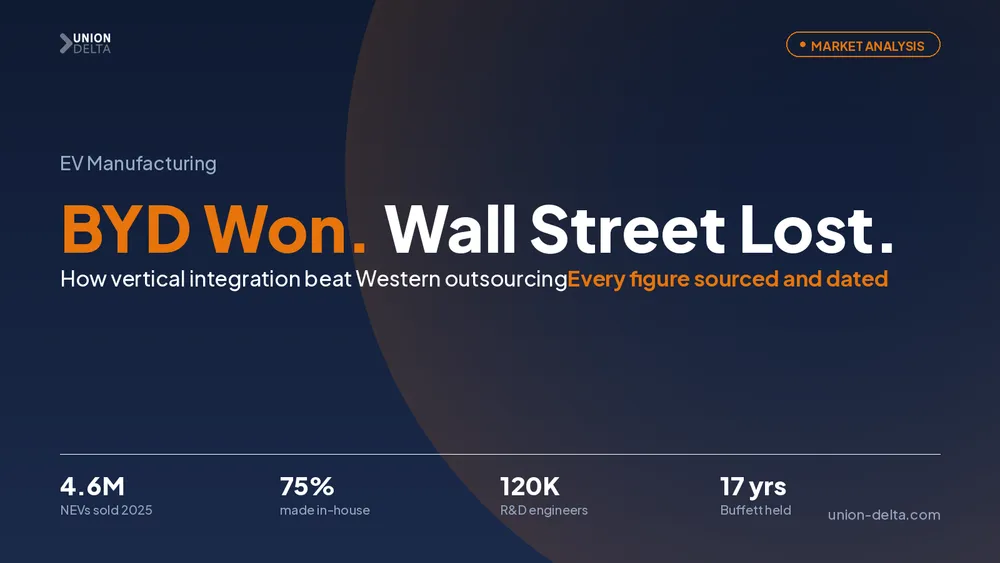
- BYD sold 4,602,436 new energy vehicles in 2025, up 7.7% year on year, and exported 1,046,083 of them — export volume grew 150.7%.
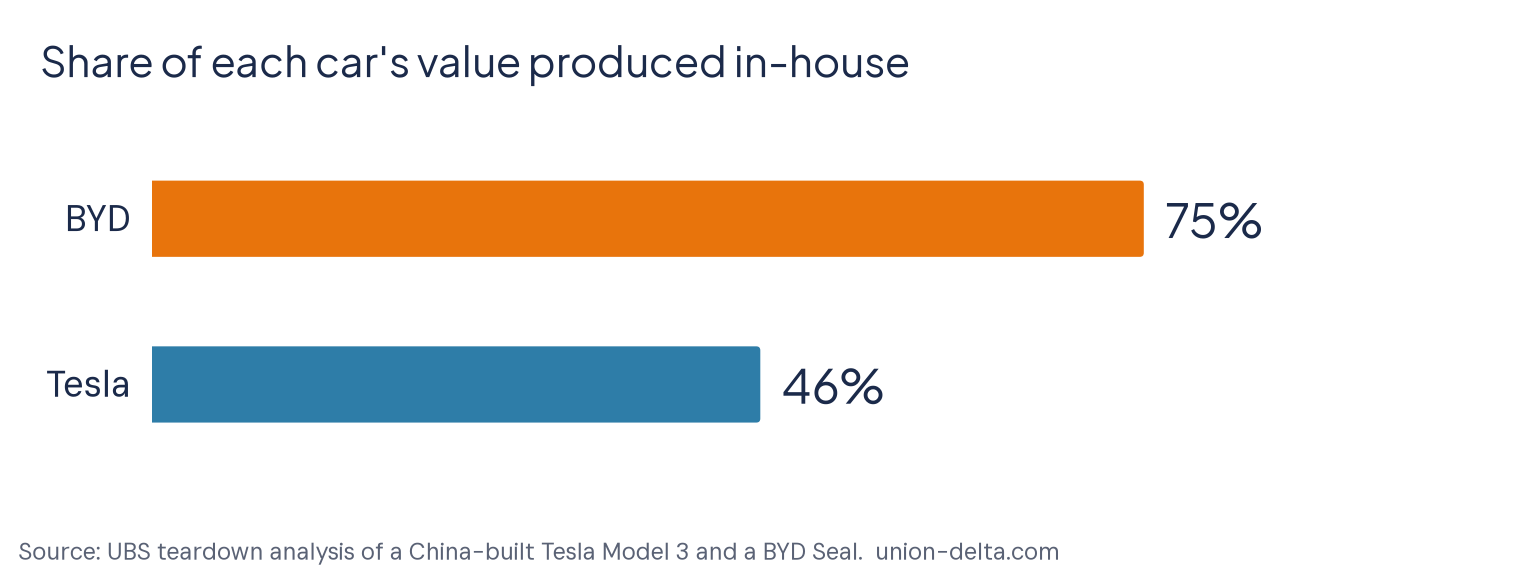
- BYD manufactures roughly 75% of each car's value in-house, versus about 46% for Tesla, according to a UBS teardown of a China-built Model 3.
- The cost advantage is not cheap labour. Direct assembly labour is a single-digit share of an EV's cost; the battery pack is roughly one third. Integration and scale, not wages, drive the gap.
- Western carmakers outsourced batteries, power electronics and software from the 1980s onward under shareholder pressure. Ford now licenses CATL battery technology; Volkswagen bought about 5% of Xpeng and licenses its electrical architecture; Audi builds on an SAIC platform.
- BYD's weakest point is not quality. It is supplier payment terms (historically about 127 days, cut to 60 in 2025) and the off-balance-sheet debt that GMT Research argues those terms concealed.
- BYD is blocked from the US mainly by the Connected Vehicle Rule, not tariffs. The rule targets who supplies the software, so a factory in Mexico does not solve it.
What actually explains BYD's cost advantage?
Vertical integration and volume, not wages. BYD designs and builds its own battery cells, motors, power semiconductors and tooling. When most carmakers need a battery, they negotiate with CATL, LG or Panasonic. When BYD needs one, it moves it between its own divisions.
UBS engineers took apart a China-built Tesla Model 3 and a BYD Seal and estimated that BYD makes about 75% of the value of its car in-house, against roughly 46% for Tesla. That gap is the single most useful number for understanding BYD, and it is worth being precise about it: 75%, not the "80%" that circulates in secondary coverage.
Integration is expensive to build. BYD reported more than 120,000 R&D engineers in its 2025 annual report, up from the 110,000 its chairman cited in December 2024, and files roughly 45 patent applications per working day — cumulatively over 71,000 applications and more than 42,000 granted. That is a heavy fixed cost. It only pays off at volume.
At volume it becomes very hard to attack. BYD earns margin on the cell, the module, the inverter and the finished car rather than paying a 25–40% supplier markup at each step. In 2025 the average price of a new energy vehicle in China fell from about RMB 180,000 to RMB 161,000, a drop of 10.6%. BYD's net profit fell 19% to RMB 32.62 billion — its first decline since 2021 — but it stayed clearly profitable through a price war that pushed weaker brands toward collapse.
Precision note: BYD's 2025 unit sales rose 7.7%, but revenue rose only 3.5% to RMB 803.96 billion. Unit growth and revenue growth are not the same story, and coverage that blurs them overstates the year.
Why "it's just cheap labour" is wrong
If low wages produced car industries, Bangladesh and Ethiopia would have them. They do not. They have garment and assembly sectors, because that is what low wages alone buy you.
The arithmetic is against the cheap-labour theory. Direct assembly labour is a single-digit percentage of what an EV costs to build. The battery pack is roughly a third. Even eliminating labour entirely would not produce BYD's price positions. What produces them is owning the battery, controlling the chemistry, and amortising a semiconductor line across millions of units.
BYD's own wage bill also argues against it. The company employed about 870,000 people at the end of 2025, down from 968,900 a year earlier after roughly 100,000 roles were removed through automation, and it pays 120,000 engineers in one of the most competitive technical labour markets in the world.
The real advantage is an ecosystem: dense supplier networks, engineers in volume, logistics, tooling, and fast feedback between design and the production line. None of that relocates to whichever country currently has the lowest wages. This is the same dynamic we described in how China became the world's factory.
Why did Western carmakers lose the manufacturing stack?
They sold it, deliberately, over four decades, because capital markets rewarded them for it.
From the 1980s onward, US and European automakers were pushed toward asset-light balance sheets. Vertical integration looked like the enemy of return on capital: factories, inventory, R&D headcount. Outsourcing looked like the cure. Component divisions were spun out — General Motors released Delphi in 1999, Ford released Visteon in 2000 — and the industry converged on designing and assembling cars whose critical parts other companies made.
For internal combustion engines it worked. The engine and gearbox, the parts that defined the product, stayed in-house. Everything outsourced was genuinely peripheral.
Electrification moved the centre of the car to exactly the parts that had been outsourced. The battery, the power electronics and the software now decide range, charging speed, cost and how the car feels to use. Firms that had spent thirty years learning not to make those things had to buy them from suppliers who had spent thirty years learning to make them.
The result is visible in who licenses what from whom:
| Western firm | What it now sources from a Chinese partner |
|---|---|
| Ford | Licenses CATL LFP battery technology for its Michigan plant |
| Volkswagen | Bought roughly 5% of Xpeng; licenses its electrical/electronic architecture for China-market models |
| Audi | Builds China-market models on an SAIC platform |
| Tesla | Uses CATL LFP cells in Megapack and Powerwall storage products |
Volkswagen's software division, Cariad, is the clearest illustration of the cost. It was created to bring software back in-house after decades of buying it, has consumed billions of euros, and has repeatedly delayed platforms across the group. Rebuilding a capability is much harder than never having sold it.
The counter-argument, stated fairly: outsourcing was not irrational. It genuinely lowered capital intensity and raised returns for twenty-five years, and Toyota's supplier-network model shows a middle path that also works. Western firms also carry legacy plants, union agreements and a higher cost of capital than BYD faced. The criticism is not that they outsourced. It is that they kept outsourcing after the battery became the product.
Is God's Eye really free, and does it matter?
Partly free, and it matters mainly as a data flywheel. This is the claim most often reported incorrectly, so the tiers are worth stating precisely:
| Tier | Hardware | Availability | Price |
|---|---|---|---|
| God's Eye C (DiPilot 100) | Cameras and radar, highway navigate-on-autopilot | Standard on 21 models, including the entry-level Seagull | Included |
| God's Eye B (DiPilot 300) | Adds lidar, urban navigate-on-autopilot | Optional on selected trims | +RMB 12,000 (~$1,700) |
| God's Eye A | Three lidars | Yangwang and Denza only | Premium models only |
So the honest formulation is: the base driver-assistance tier is standard across the range, including a car that starts around $10,300; the lidar-based urban tier is a paid option, and BYD has raised its price. "Free autonomy on everything" is marketing, not fact.
The strategically interesting part is deployment. BYD reported the system on more than 3.33 million vehicles as of 15 July 2026, up from 2.3 million in January 2026.
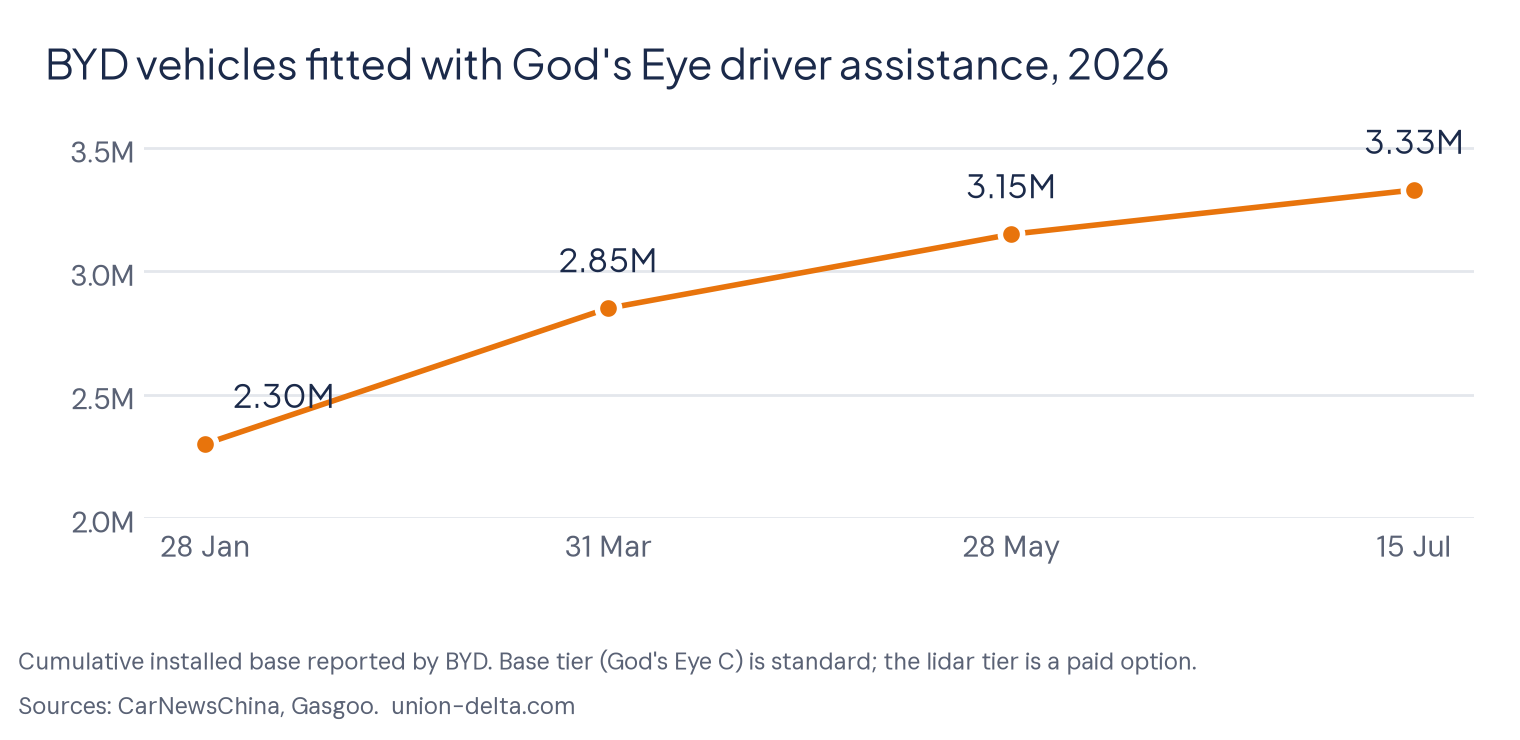
Every one of those cars generates edge cases. Driver assistance improves through exposure to rare events, which is why fleet size compounds: more cars produce more corner cases, which improve the model, which justifies wider deployment. It is the same mechanism that gave Tesla its early Autopilot lead.
Is BYD's system actually good?
Not yet at the top, and the evidence is more specific than the usual claims. In July 2025 the Chinese outlet Dongchedi ran the largest independent assisted-driving test to date: 36 vehicles, 15 hazard scenarios, 216 recorded collisions.
- Highway scenarios: Tesla led (Model 3 and Model X passed 5 of 6). Xpeng G6, Aito M9 and Luxeed R7 passed 3 of 6. BYD did poorly — Tang L DM passed 1 of 5, Han L passed 0 of 5.
- Urban scenarios: Tesla Model X led with 8 of 9. Huawei-equipped cars followed (Luxeed R7 and Avatr 12, 7 of 9). BYD's Bao 5 scored 6 of 9 — ahead of the Xpeng G6 and P7+, which managed 3 of 9.
The accurate summary: Huawei's stack is measurably ahead of BYD's; Xpeng's is not, in city driving. Separately, NIO and BYD were among the first to receive Chinese L3 pilot approval, while Tesla and Xpeng were not. BYD's bet is not to lead on capability today but to lead on installed base, and to close the gap with data.
What are the strongest criticisms of BYD?
Any assessment that cannot name them is not an assessment. There are two serious ones, and neither is about build quality.
1. Supplier payment terms
BYD historically paid suppliers on roughly 127-day terms, against an industry norm of 45–60 days and about 60 days at Tesla. Much of it was settled not in cash but in supply-chain notes through its Dilian and Dilink platforms, which reached an estimated RMB 400 billion by May 2023. Small suppliers financed BYD's growth.
Chinese regulation effective 1 June 2025 required payment to small and medium suppliers within 30 days by default, 60 if contractually agreed, and prohibited forcing suppliers to accept promissory notes. Around 14–17 automakers pledged compliance. BYD and Geely applied the 60-day standard to all suppliers, not only SMEs — a genuine improvement, and BYD was far from the worst offender (NIO reportedly ran to 195 days, Changan beyond 200). Sub-tier suppliers deeper in the chain remain under pressure.
2. Off-balance-sheet leverage
BYD's reported net debt was about RMB 27.7 billion ($3.78 billion) in mid-2024. GMT Research argued the economically comparable figure was closer to RMB 323 billion ($44.1 billion) once receivables sold off balance sheet and payables stretched past 90 days were treated as debt-like. The mechanism is precisely the payment terms above: extreme supplier float makes reported net debt look small.
BYD disputes the characterisation, and reported net debt is genuinely low. The useful conclusion is narrower and more durable: BYD's headline net debt figure is not informative either way, so arguments built on it — from either direction — are weak.
3. Execution errors do happen
In 2026 BYD Australia sold 1,265 vehicles built in 2025 as model-year 2026 cars, because contracts recorded the factory dispatch date rather than the build date. Affected models were the Atto 3, Shark 6 and Sealion 8. BYD offered three remedies — exchange for a genuine MY26 car at the same price, A$1,100 compensation, or a full refund — and the ACCC became involved. It was handled reasonably, and it is the kind of error scale produces.
What is not a valid criticism: safety. BYD has earned nine maximum five-star Euro NCAP ratings since entering Europe in 2022, across its whole range. The Sealion 7 scored 93% for child occupant protection, the best result Euro NCAP had recorded in nine years. Same laboratories, same protocol as every European brand. Whether you want to buy from a Chinese brand is a legitimate question; "the cars are unsafe" is not supported by the test data.
Why can't Americans buy a BYD?
Tariffs are the visible barrier. The Connected Vehicle Rule is the real one.
Section 301 duties plus subsequent measures push the effective tariff on a China-built EV above 100%, which alone would make BYD uncompetitive in the US. Tariffs, however, are negotiable and change with administrations.
The structural barrier is the Commerce Department rule finalised on 16 January 2025 and effective from 17 March 2025. It prohibits the import or sale of connected vehicles under 10,000 lbs GVWR containing Vehicle Connectivity System software or Automated Driving System software designed, developed, manufactured or supplied by entities owned by, controlled by, or subject to the jurisdiction of China or Russia.
| Scope | Applies from |
|---|---|
| Covered software (VCS and ADS) | Model year 2027; practical compliance date 30 September 2026 |
| Covered hardware (VCS) | Model year 2030, or 1 January 2029 for units without a model year |
The trigger is the nationality and control of the supplier, not the location of assembly. A BYD plant in Mexico does not change who wrote and supplied the connectivity and driver-assistance software, so it does not solve the problem. This is why the rule is far more consequential than tariffs: it is national-security policy, not trade policy, and it does not respond to price.
Two caveats worth stating. The rule covers VCS and ADS software specifically, not every line of code in a vehicle. And BYD has publicly framed its Mexican plant as serving Mexico, while separately suing in February 2026 through four US subsidiaries for the refund of duties paid since April 2025. For how tariff policy interacts with sourcing decisions more broadly, see our analysis of Section 301 and forced-labour tariffs.
How does BYD compare with Tesla and its Chinese rivals?
The Tesla comparison is frequently made with mismatched numbers, so here it is with matched ones.
| Metric | Tesla | BYD |
|---|---|---|
| Vehicles delivered, 2025 | 1,636,129 (−8.6%) | 4,602,436 (+7.7%) |
| Value produced in-house | ~46% | ~75% |
| Total employees | 134,785 | ~870,000 |
| Driver-assistance engineering team | not disclosed | 5,000+ |
| Primary advantage | Software, autonomy, charging network | Scale, integration, cost |
Note: comparisons of "R&D engineers" between the two are usually invalid. BYD's 120,000 covers vehicles, batteries, electronics and semiconductors group-wide; Tesla does not publish an engineering headcount, though outside estimates put it near 17,800.
Tesla's Full Self-Driving pricing is also widely misreported. Tesla removed the one-time FSD purchase in the US in February 2026; before that it had been $8,000, not the $12,000–15,000 still repeated in older coverage. It is now sold as a $99 per month subscription ($49 for owners of Enhanced Autopilot), with outright purchase surviving only in certain Model S/X and Cybertruck packages.
The two companies are not really running the same race. Tesla is valued on autonomy and energy optionality, trading at a price-to-earnings ratio far above BYD's. BYD is valued much closer to an industrial manufacturer. Both can be right about their own strategy.
The Chinese field, corrected
Coverage of China's other EV makers is unusually error-prone, particularly around Huawei's alliance brands, which are frequently attributed to the wrong manufacturer.
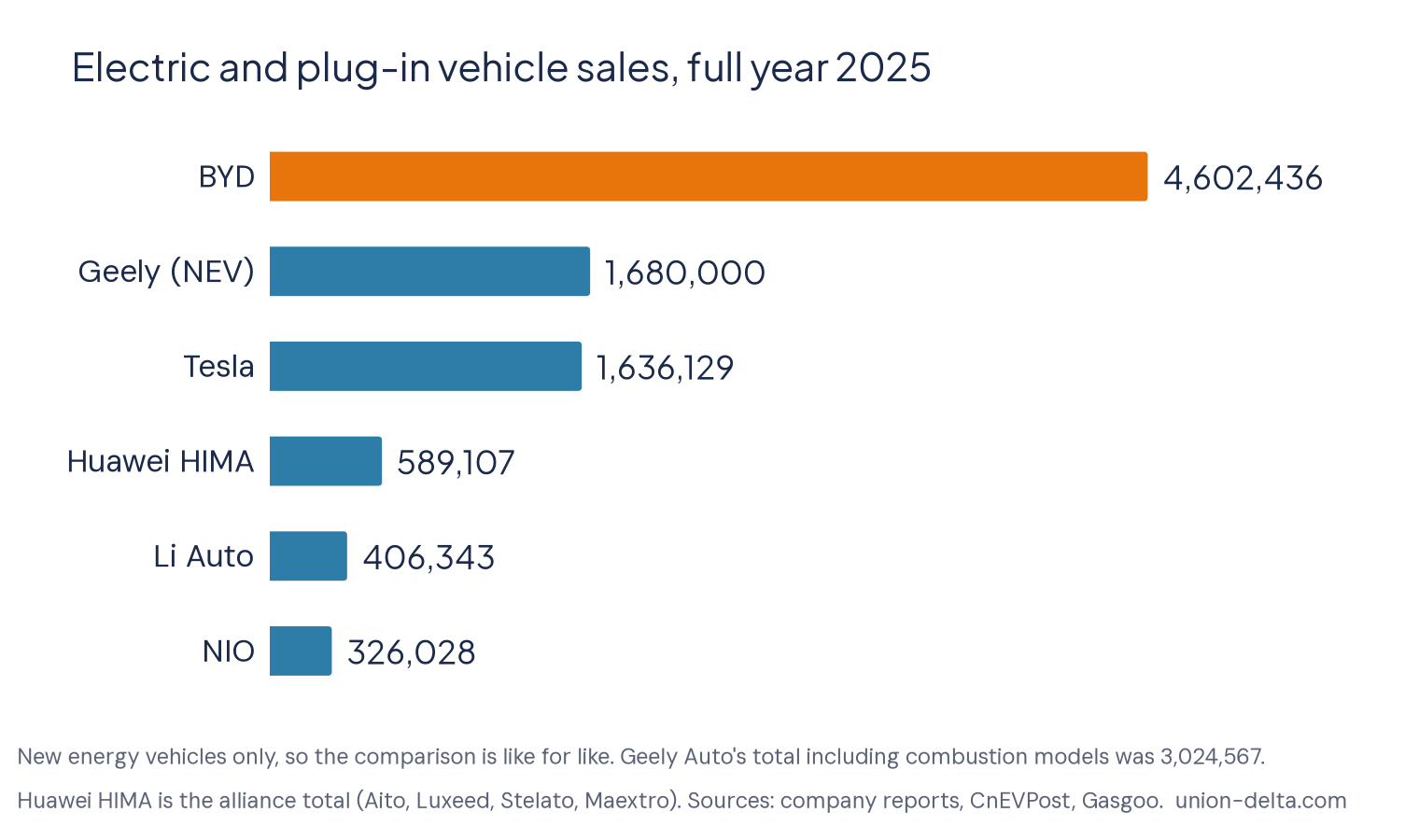
| Brand | 2025 volume | Who builds it | Strategy |
|---|---|---|---|
| BYD | 4,602,436 | BYD | Scale and vertical integration |
| Geely Auto | 3,024,567 (1.68M NEV) | Geely | Multi-brand, owns Volvo and Polestar |
| Huawei HIMA (alliance total) | 589,107 | Partner OEMs | Huawei supplies software and autonomy |
| — Aito | ~426,000 | Seres + Huawei | M5–M9 SUVs, EREV and BEV |
| — Luxeed | included above | Chery + Huawei | S7 sedan, R7 SUV |
| — Stelato | included above | BAIC + Huawei | S9 luxury sedan, S9T wagon |
| — Maextro | included above | JAC + Huawei | Ultra-luxury; S800 from RMB 708,000 |
| Li Auto | 406,343 (−18.8%) | Li Auto | Range-extended hybrids, ~85–90% of volume |
| NIO | 326,028 (+46.9%) | NIO | Premium, battery swapping |
Three corrections worth carrying forward, because they appear in a great deal of published coverage:
- Stelato is BAIC and Huawei, not Chery and Huawei. Chery's Huawei brand is Luxeed. JAC's is Maextro.
- There is no "Aito S8". Aito builds M5, M6, M7, M8 and M9. The S-names belong to other alliance brands: Luxeed S7, Stelato S9, Maextro S800.
- Li Auto is not China's largest EV and hybrid seller. BYD outsells it roughly ten to one, and Li Auto's 2025 volume declined 18.8%.
NIO's position also deserves precision: it reached its first quarterly profit in Q4 2025 (operating profit RMB 807.3 million), but remained loss-making across the full year. "NIO is profitable" is premature; "NIO reached quarterly profitability" is accurate.
What does BYD build besides cars?
The non-automotive work is the strongest evidence that BYD is a manufacturing system rather than a car company, and it is also where reporting tends to overstate BYD's role. Three verified examples:
- Grid storage. In July 2026 BYD Energy Storage contracted to supply 11.275 GWh for the Masdar and EWEC round-the-clock solar project in Abu Dhabi, which pairs 5.2 GW of solar with 19 GWh of storage — the largest battery storage project in the world, targeted for 2027. BYD supplies the majority of it, not all of it.
- Rail. São Paulo's Line 17-Gold opened on 31 March 2026, BYD's first SkyRail deployment outside China. BYD supplied 14 five-car trainsets, signalling, telecoms and platform screen doors. It did not design or build the line — the civil works long predate its involvement, and this is not São Paulo's first monorail, since Line 15-Silver has run since 2014.
- Emergency manufacturing. In early 2020 BYD assembled a task force of over 3,000 engineers, produced 400+ equipment drawings in three days, and completed development and manufacture of its own mask-making machines in seven days, against an industry norm of 15–30 days, self-manufacturing about 90% of the 1,300+ components. By 13 March 2020 it was the world's largest mask producer at five million per day.
The mask episode is the cleanest demonstration of the underlying capability. The company did not have mask machines. It had tooling, motors, controls and engineers, so it built the machines that build the product. That is what owning the stack buys.
Where can you actually buy a BYD?
| Market | Status | Detail |
|---|---|---|
| China | Full range | Seagull from ~RMB 69,900 up to Yangwang above RMB 1M |
| Australia | Near market leader | June 2026: 18,881 sales vs Toyota's 19,124, a gap of 243 cars; BYD led 5 of 8 states and territories |
| Europe | Growing | Passenger models expanding; over 7,000 BYD electric buses across 26 countries |
| Brazil | Growing | Local assembly; SkyRail trainsets in São Paulo |
| UK | Available | Atto 3, Seal, Dolphin, Sealion |
| USA | Blocked | Tariffs above 100% plus the Connected Vehicle Rule |
Australia is the clearest test case, because BYD competes there without tariff protection against Toyota, and in June 2026 came within 243 cars of the number one position in an all-time record market.
If you are buying: BYD's vehicle warranty in China is 6 years or 150,000 km, with 8 years or 160,000 km on the battery, extended in Europe to 8 years or 250,000 km. Terms vary by market, so check locally. The most common misconception worth correcting: the Seagull is a five-door hatchback, not a sedan, and after the May 2026 model-year update it starts at RMB 69,900 (about $10,300), no longer under $10,000.
Was Warren Buffett's BYD investment vindicated?
Yes, and the detail is more interesting than the headline.
On 29 September 2008, Berkshire Hathaway Energy bought 225 million BYD shares at HK$8, about $230 million for roughly 10% of the company. It was Charlie Munger's idea, not Buffett's — a distinction usually lost in retelling. Munger described BYD founder Wang Chuanfu to Fortune in April 2009 as "a combination of Thomas Edison and Jack Welch: something like Edison in solving technical problems, and something like Welch in getting done what he needs to do."
Berkshire began trimming in August 2022 and completed its exit by September 2025, roughly a 17-year holding, on an estimated $8–10 billion gain. The stock rose over 4,000% across the period.
What the episode does and does not prove is worth separating. It does not prove BYD is a good investment now: Berkshire sold, and Berkshire — a company worth about $1.07 trillion in 2026 — sells for reasons of capital allocation as often as conviction. What it does demonstrate is that the vertical-integration thesis was legible to serious outside analysts in 2008, when Tesla was near bankruptcy and Western automakers were posting record profits. The strategy was not a lucky outcome discovered afterwards. It was visible, in advance, to people who looked at the manufacturing.
Disclosure: the author has held BYD shares since 2016.
Frequently asked questions
Is BYD bigger than Tesla?
Yes, by volume. BYD sold 4,602,436 new energy vehicles in 2025 against Tesla's 1,636,129 deliveries — roughly 2.8 times as many. Tesla remains larger by market capitalisation and earns a higher margin per car.
Why are BYD cars cheaper?
Vertical integration and scale, not labour costs. BYD makes about 75% of each car's value in-house versus roughly 46% at Tesla, so it captures margin at every stage instead of paying supplier markups. Direct assembly labour is a single-digit share of an EV's cost, while the battery pack is about a third — and BYD makes its own batteries.
Can I buy a BYD in the United States?
No. BYD does not sell passenger cars through US dealers. Two barriers apply: an effective tariff above 100% on China-built EVs, and the Connected Vehicle Rule, which from model year 2027 bars connectivity and automated-driving software supplied by Chinese-controlled entities. Because the rule targets the supplier rather than the assembly location, building cars in Mexico would not resolve it.
Is God's Eye driver assistance free on all BYD models?
Only the base tier. God's Eye C, which uses cameras and radar and supports highway navigate-on-autopilot, is standard on 21 models including the entry-level Seagull. God's Eye B, which adds lidar and urban navigate-on-autopilot, is a paid option costing about RMB 12,000 (roughly $1,700), and BYD has raised that price. As of 15 July 2026 the system was fitted to more than 3.33 million vehicles.
Are BYD cars safe?
By European test standards, yes. BYD has received nine maximum five-star Euro NCAP ratings since entering Europe in 2022, across its full range. The Sealion 7 recorded 93% for child occupant protection, the highest Euro NCAP had measured in nine years. These are the same laboratories and protocols applied to European brands.
What is the strongest criticism of BYD?
Supplier payment terms. BYD historically paid suppliers on roughly 127-day terms against an industry norm of 45–60 days, often settling in supply-chain notes rather than cash. GMT Research argued this concealed debt-like obligations, estimating an adjusted net debt near RMB 323 billion against RMB 27.7 billion reported. Chinese regulation effective 1 June 2025 capped SME payment terms at 60 days, and BYD applied that standard to all suppliers.
Did Warren Buffett make money on BYD?
Yes. Berkshire Hathaway Energy invested about $230 million in September 2008 for roughly 10% of BYD, on Charlie Munger's recommendation, and exited fully by September 2025 for an estimated gain of $8–10 billion over roughly 17 years.
Does BYD make anything other than cars?
Yes. BYD began in 1995 as a battery manufacturer supplying Motorola and Nokia, and entered cars only in 2003. It now produces grid-scale storage — including 11.275 GWh for the Masdar round-the-clock solar project in Abu Dhabi — electric buses, monorail rolling stock, semiconductors and consumer electronics components.
Sources and method
How this article was fact-checked
Every quantitative claim was verified against a primary or first-tier source published between January and July 2026. Where a widely circulated figure proved outdated or incorrect, we state the corrected figure and flag the discrepancy rather than repeating the popular version.
Primary sources: BYD 2025 annual report; Tesla Q4 2025 delivery report and 10-K; NIO, Li Auto and Geely Auto investor releases; US Bureau of Industry and Security final rule on connected vehicles (16 January 2025); Euro NCAP published ratings; Dongchedi assisted-driving test (July 2025); UBS teardown analysis; GMT Research; VFACTS Australia (June 2026); CnEVPost, Gasgoo and CarNewsChina for Chinese market volumes.
Corrections we make to common reporting: BYD's in-house share is approximately 75%, not 80%. Export growth in 2025 was 150.7%, not 140%. Tesla delivered 1,636,129 vehicles in 2025, not 1.8 million. Tesla FSD no longer has a one-time purchase price in the US. Stelato is a BAIC partnership, not Chery. There is no Aito S8. The Seagull is a hatchback and no longer starts below $10,000.
Last updated: 26 July 2026. If you find an error in this article, write to us and we will correct it and note the change here.
Sourcing from China?
Union Delta handles supplier identification, quality control, consolidation and DDP freight for companies importing from China. The same supply-chain depth described in this article is what we navigate for clients every week.
Get a sourcing quoteThe factory floor, in 60 seconds
Short videos from the real work: factory visits, sourcing traps, and the freight reality behind a China-to-USA supply chain.