
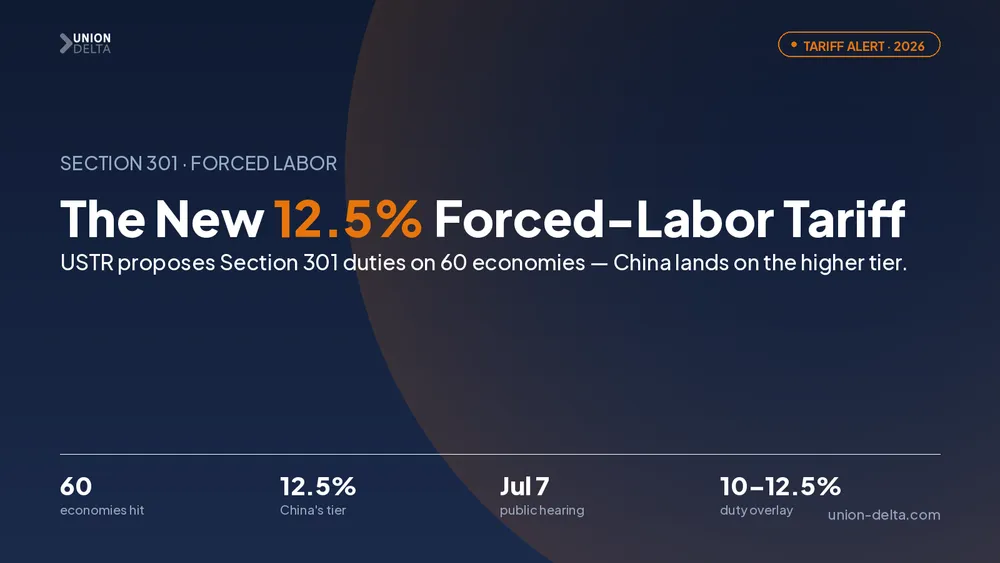
There is a new number headed for your customs bill, and it is not small. On June 2, 2026, the Office of the U.S. Trade Representative (USTR) issued findings in 60 Section 301 investigations and proposed an additional 10% to 12.5% tariff on economies it says fail to ban or enforce a prohibition on goods made with forced labor. China is slated for the higher 12.5% rate — stacked on top of every duty you already pay.
What actually happened — the 60-second version
This is a Section 301 action — the same statute behind the original 2018 China tariffs. That matters, because Section 301 gives the executive branch broad authority to impose duties without new legislation. The timeline is short and recent:
| Date | What happened |
|---|---|
| Mar 12, 2026 | USTR opens 60 investigations into whether trading partners ban and police goods made with forced labor. |
| Jun 2, 2026 | USTR finds all 60 economies "actionable" under Section 301 and proposes a 10%–12.5% tariff overlay. |
| Jul 6, 2026 | Deadline for written public comments. This is your window to influence exclusions. |
| Jul 7, 2026 | Public hearing. Duties take effect only after this process concludes. |
The two tiers: 10% vs 12.5%, and where China lands
The proposal sorts the 60 economies into two buckets based on whether they already have a forced-labor import prohibition in force:
| Tier | Who it applies to | Added duty |
|---|---|---|
| Lower | Economies with a prohibition in place, a reciprocal-trade commitment, or a partial regime — e.g. Canada, the EU, Mexico, Indonesia, Ecuador, Pakistan | 10% |
| Higher | All other investigated economies — China included | 12.5% |
Of the 60 economies, 54 have neither imposed nor effectively enforced a forced-labor import ban. Six others maintain a prohibition on paper but, in USTR's view, fail to enforce it — those six land in the 10% tier. The proposal carries product- and program-specific exclusions, so not every HTS code is automatically hit. Which brings us to the part that actually decides your margin.
The part that hurts: this is an overlay, not a replacement
The headline "12.5%" is not your total tariff. It is an extra layer on top of everything you already pay. For a typical China-sourced consumer product, your duty bill is a stack:
- Base (MFN) duty for your HTS code — roughly 0–16%
- Existing Section 301 China duties — 7.5–25%
- Any other 2026 tariff layers that apply to your code
- + the proposed 10–12.5% forced-labor overlay
A real dollar example (this is what your CFO will ask)
Numbers beat adjectives. Take a single product with a $10.00 factory (FOB) value, applied to customs value — illustrative, simplified, but the shape is real:
| Duty component | Rate | Per unit |
|---|---|---|
| Base MFN duty (illustrative) | 5% | $0.50 |
| Section 301 China (illustrative) | 25% | $2.50 |
| Duty today | 30% | $3.00 |
| + New forced-labor overlay | 12.5% | +$1.25 |
| Duty if proposal passes | 42.5% | $4.25 |
That overlay adds $1.25 per unit. Feels minor — until you multiply. On a 10,000-unit shipment, the forced-labor overlay alone is an extra $12,500 in duty, on goods that already carried $30,000 in duty before it. For thin-margin Amazon and DTC products, $1.25 a unit is frequently the difference between a healthy SKU and a dead one. Run it on your actual FOB and your real HTS rates before you assume you can absorb it.

If you have never built your duty stack out layer by layer, start now. We walk through the full math, by category, in our guide to Amazon FBA tariff rates for 2026, with a landed-cost calculator you can run on your own SKUs.
Why this lands on top of an already brutal year
This proposal does not arrive in a vacuum. The end of the $800 de minimis exemption already forced every commercial shipment into formal customs clearance, with duties and brokerage fees attached. Stack a forced-labor overlay on top and the math gets unforgiving for anyone still sourcing single-origin from China. That is precisely why "China+1" — keeping China but adding a second-country supplier — is back on every importer's whiteboard. The point is not to flee China; it is to stop being 100% exposed to one tariff lever.
Forced labor means traceability — not just a tariff
There is a compliance dimension here, separate from the duty. Forced-labor enforcement is fundamentally about provenance: can you show where your goods, and their inputs, actually came from? Importers who already keep clean supplier documentation — sub-tier mapping, not just the final factory — will navigate this far more smoothly than those who only know their last-stop vendor.
Your move: a practical checklist
What to do before July 6
- Re-run landed cost per SKU with a 12.5% overlay modeled in. Flag which products go underwater before the duty is final, not after.
- Verify your HTS classifications. Exclusions will be product-specific — the right code could be the line between paying the overlay and being excluded from it.
- Map supplier origins. If part of your range can shift to a 10%-tier or excluded economy, model the all-in cost (freight + duty + lead time), not just unit price.
- Tighten documentation. Build traceability down to sub-suppliers now, while it is a planning task and not an emergency.
- Comment if it matters. Industry comments genuinely shape exclusion lists. The window closes July 6, 2026.
How Union Delta helps
We are on the ground in China and source across categories, so we help importers move fast on three fronts: modeling true landed cost under the new stack, checking HTS codes and exclusion eligibility, and evaluating alternative-origin suppliers when diversification actually pencils out. The goal is simple — no surprises on your customs bill, and a supply chain that survives the next policy headline.