
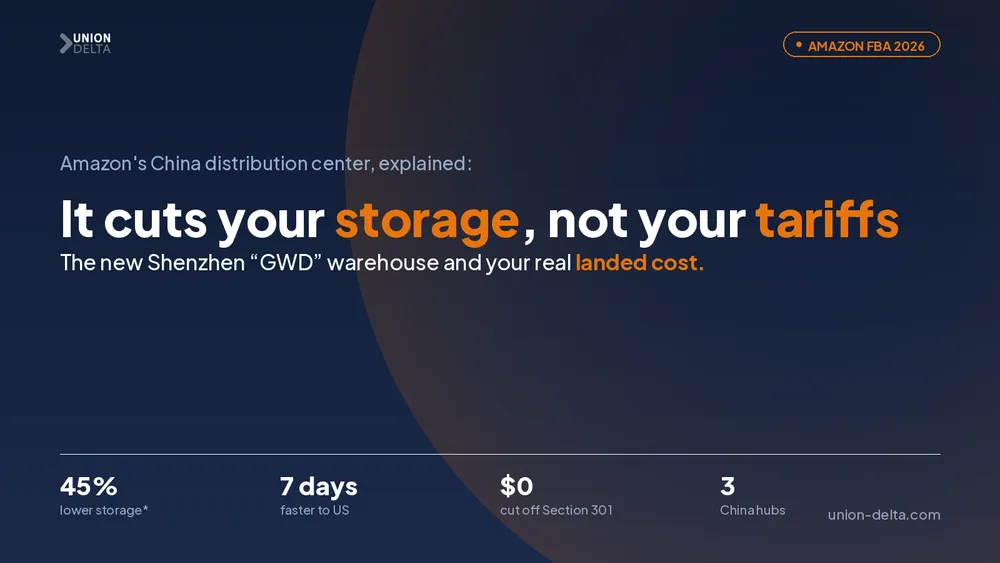
If you sell on Amazon and source from China, you've probably seen the headlines this month: "Amazon opens a distribution center in China," "Shenzhen smart warehouse cuts seller storage costs by 45%," "inventory reaches US buyers seven days faster." The natural question for anyone importing product is the one everyone is quietly asking: does this finally lower my landed cost?
The honest answer is: it lowers some of your costs — and none of the one that hurts most. This article explains exactly what Amazon launched, what it does and doesn't do, and how to decide whether it belongs in your supply chain. No hype, just the mechanics.
What Amazon Actually Launched (It's Called GWD)
The program is Global Warehousing & Distribution (GWD). Amazon opened its first China smart warehouse in Shenzhen (Yantian) in April 2026, and expanded this month with two more hubs in Shanghai and Ningbo, plus new features and a storage promotion.
Here's the important part most headlines skip: GWD is not a direct-to-consumer service, and it is not a new "China retail import" program. It's a bulk-storage warehouse that sits near your factory, inside China, and feeds Amazon's US fulfillment network. You store finished goods there cheaply, then replenish into US fulfillment centers on demand from Seller Central. The cross-border leg still runs on Amazon Global Logistics (AGL), Amazon's existing freight-and-customs pipeline.
Think of it as the China-origin sibling of AWD (Amazon Warehousing & Distribution), the US-based bulk-storage service that auto-replenishes FBA. GWD is the same idea, moved upstream: instead of paying US warehouse rates to hold a quarter of inventory, you hold it in China where storage is cheaper, and drip it into the US as you sell.
| Service | Where inventory sits | What it does |
|---|---|---|
| GWD (new) | China (Shenzhen, Shanghai, Ningbo) | Cheap bulk storage near the factory; replenishes US FCs via AGL |
| AWD | United States | US bulk storage that auto-replenishes FBA |
| AGL | In transit | Freight + customs clearance from China to the US |
| FBA | US fulfillment centers | Pick, pack, ship to the customer |
What It Actually Saves You
Amazon's pitch rests on two numbers:
- Up to 45% lower storage cost versus holding the same inventory in US-based AWD. This is plausible on its face — Chinese warehouse space is cheaper than US warehouse space, full stop.
- Up to 7 days faster replenishment into US fulfillment centers — but only when GWD is paired with Amazon Global Logistics, because Amazon then controls the whole chain end to end.
On top of that, there's a launch promotion: goods received into the Shenzhen, Shanghai, or Ningbo warehouses between July 1 and December 31, 2026 get 30 days of free storage from the receiving date. New features added this month include auto-restock recommendations and support for FOB trade terms.
For a seller who chronically over-buys US warehouse space to avoid stockouts, that storage saving is genuine money. If you're paying AWD or FBA long-term storage fees on slow-moving inventory, holding the buffer in China instead can meaningfully cut your carrying cost.
The Part the Headlines Get Wrong: It Does NOT Cut Your Tariffs
This is the single most important thing to understand, and it's where a lot of sellers are about to make an expensive assumption.
Shipping your goods out of a Chinese Amazon warehouse does not lower your Section 301 tariffs. Not by a cent.
US duties are assessed on country of origin — where the product was made — not on the country it was shipped from. A keychain manufactured in Guangdong is Chinese-origin whether it leaves China from your forwarder's dock, from a third-party 3PL, or from Amazon's new Shenzhen GWD facility. It pays the same Section 301 duty, the same reciprocal/IEEPA tariffs, and clears the same formal customs entry either way. Only genuine substantial transformation in a third country changes origin — and warehousing is not transformation.
So the honest way to read Amazon's launch is this: GWD is Amazon's answer to the end of de minimis, not to tariffs. The $800 duty-free exemption was killed for China in May 2025 and for every other country in February 2026. Amazon also shut down its own China-based FBA prep-and-ship service on January 1, 2026. Every parcel now needs a formal, duty-paid entry. GWD is Amazon re-inserting itself into that new bulk-import, duty-paid world — making the storage and logistics cheaper and smoother. It does nothing to reduce the duty you owe.
What This Looks Like in Your Landed Cost
Here's the mental model. Your landed cost is roughly:
GWD touches Storage (down ~45% on the portion you hold in China) and can shave a few days off Freight lead time. It leaves Product and Duties exactly where they were. If duties are 30–50% of your product cost — which they are for a lot of categories right now — then trimming storage is a nice optimization, but it will never be the thing that saves a margin that tariffs already broke.
The sellers who benefit most from GWD are the ones who already have healthy unit economics and simply want cheaper buffer stock and faster restocks. The sellers hoping it rescues a product that's underwater on tariffs are going to be disappointed — that problem gets solved at the sourcing layer (renegotiated factory price, correct HTS classification, or diversifying origin), not the warehousing layer.
Who Can Actually Use It?
Most of the reporting frames GWD around China-based sellers — and that's the honest state of things, because Chinese sellers make up roughly half of Amazon's active seller base and they're the obvious first audience for a China-origin warehouse.
What we can't yet confirm is the fine print that matters to a US- or Hong-Kong-registered brand: exact eligibility, product-category restrictions, and — critically — the actual GWD rate card. Amazon has not published per-cubic-foot storage rates or minimum volume thresholds for GWD, and none of the launch coverage did either. So treat the "45%" as a directional claim until you see your own quoted rates inside Seller Central. Don't rebuild your supply chain around a number you haven't been individually quoted.
Should You Use GWD? A Simple Decision Guide
GWD probably helps you if…
- You already import in bulk and pay meaningful US-side storage or long-term storage fees on buffer inventory.
- You have steady, predictable demand and want to hold safety stock cheaply upstream while drip-feeding US fulfillment centers.
- Your unit economics already work with full tariffs, and you're optimizing carrying cost, not rescuing margin.
- You can use Amazon Global Logistics for the cross-border leg (that's where the "7 days faster" comes from).
GWD won't fix it if…
- Your product is underwater because of Section 301 or reciprocal tariffs — warehousing changes none of that.
- You were hoping "ship from a China DC" is a tariff workaround. It isn't, and treating it as one is a compliance risk.
- You want independence from a single platform for your whole supply chain — GWD deepens your dependence on Amazon's logistics stack.
- Your volume is too small to justify a bulk-storage model at all.
The Bigger Picture
Strip away the marketing and GWD is a smart, defensive move by Amazon: with de minimis gone and its own China prep service shut down, Amazon is rebuilding a China-side on-ramp so sellers stay inside its logistics ecosystem instead of drifting to independent forwarders and 3PLs. For the right seller, it's a legitimately useful tool that lowers storage cost and tightens restock timing.
But it is a logistics tool, and logistics was never your biggest problem in 2026 — tariffs and origin were. The sellers who win over the next couple of years are the ones who get their sourcing right first: correct HTS classification, factory pricing negotiated against the new duty reality, and a clear-eyed view of whether a product should stay China-origin at all or move under a China Plus One strategy. Cheaper warehousing is a nice bonus on top of a supply chain that already works — it's not a substitute for one that doesn't.
What to Do This Week
- Calculate your true landed cost per SKU — product + freight + all duties + storage + fees. If tariffs are the dominant line, GWD is not your answer.
- Check GWD eligibility and your actual quoted rates in Seller Central rather than trusting the 45% headline. Model it against what you pay for US storage today.
- Separate the two problems. Storage and lead time are a logistics question GWD can help with. Margin destroyed by tariffs is a sourcing question — fix that first.
- Don't treat any China warehouse as a tariff workaround. Origin, not export point, sets your duty. CBP enforcement on this is active and unforgiving.
Frequently Asked Questions
Does Amazon's China distribution center lower my tariffs?
No. Amazon's GWD warehouse does not reduce Section 301 or reciprocal tariffs. US import duty is assessed on a product's country of origin — where it was manufactured — not the country it is shipped from. China-made goods remain Chinese-origin and pay the same duty whether they leave China from a private forwarder, a third-party 3PL, or Amazon's Shenzhen GWD facility.
What is Amazon GWD?
GWD stands for Global Warehousing & Distribution. It is a bulk-storage service inside China, near the factory, that holds a seller's finished inventory and then replenishes Amazon's US fulfillment centers on demand. The cross-border leg runs on Amazon Global Logistics (AGL). GWD is the China-origin counterpart to AWD, Amazon's US-based bulk-storage service.
How much does Amazon GWD actually save?
Amazon states GWD can cut storage cost by up to 45% versus US-based AWD storage, and move inventory into US fulfillment centers up to 7 days faster when paired with Amazon Global Logistics. Both figures are Amazon's own marketing claims. GWD saves on storage and lead time only — it does not reduce product cost or duties.
Where are Amazon's GWD warehouses in China?
Amazon opened its first GWD warehouse in Shenzhen (Yantian) in April 2026 and added two more hubs in Shanghai and Ningbo in July 2026. Goods received between July 1 and December 31, 2026 qualify for a promotion of 30 days of free storage from the receiving date.
Can US- or Hong-Kong-registered sellers use GWD?
Most launch coverage frames GWD around China-based sellers, and Amazon has not published a public rate card, minimum volume thresholds, or full eligibility rules. Sellers registered outside mainland China should confirm eligibility and their actual quoted rates in Seller Central before planning around the program.
Is shipping from a China warehouse a way to avoid tariffs?
No, and treating it as one is a compliance risk. Only genuine substantial transformation in a third country changes a product's country of origin. Simply storing or transshipping Chinese-made goods through another warehouse or country does not change origin, and CBP actively enforces against origin misdeclaration.
Fix the number that actually moves your margin.
GWD trims storage. We help US importers cut the big line — sourcing the right factory, getting HTS classification right, and modeling landed cost with tariffs included. 12+ years in Guangzhou. Free sourcing audit for new clients.
Get a Free Sourcing Quote