
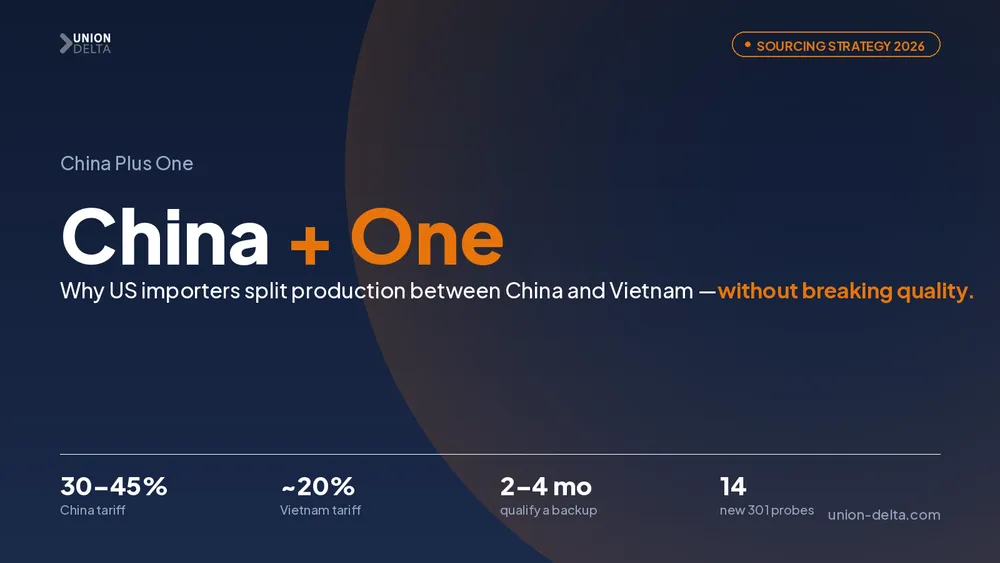
For twenty years, the sourcing playbook for US importers was simple: find the cheapest capable factory in China and ride it. That playbook is now a liability. In 2026, a single-country China supply chain means one executive order, one Section 301 ruling, or one forced-labor probe can wipe out your margin overnight — with no backup and no leverage.
The market has already started moving. Vietnam has overtaken China as the top supplier of apparel to the United States. Walmart, Nike, and a long list of mid-market brands are publicly shifting volume out of China. And the search data backs it up: "China plus one" went from a consultant's buzzword to something real importers type into Google before they place their next order.
This guide explains what China Plus One actually means in practice, why it matters more in 2026 than ever, where the real tariff numbers land by country, which products should move and which should stay in China, and exactly how to qualify a second supplier without blowing up your quality or your timeline.
What "China Plus One" Actually Means
China Plus One is not "leave China." That's the mistake most people make when they first hear the phrase. It's a risk-management strategy: keep your primary production in China — where the supplier network is still the deepest, fastest, and most capable in the world — while qualifying a backup supplier in a second, lower-tariff country.
The "plus one" is usually Vietnam, but it can be Mexico, India, Cambodia, or Indonesia depending on your product. The point isn't to replace China. It's to have optionality:
- When a new tariff hits, you shift volume to the backup instead of eating the cost.
- When a forced-labor or compliance issue freezes a category, you already have documentation and a qualified alternative.
- When lead times blow out at Chinese New Year or during a freight spike, you split orders across two origins.
- When you negotiate, your China factory knows you have somewhere else to go. That alone is worth real money.
Done right, China Plus One costs you almost nothing in steady state — your main orders still flow through China — but it turns the next tariff shock from an emergency into a routing decision.
Why 2026 Forced the Issue
Supply chain diversification has been talked about since the first trade war in 2018. What changed is that in 2026 the cost of not diversifying finally became larger than the cost of doing it. Four things stacked up:
- The tariff stack got heavier. A typical Chinese consumer-goods shipment now carries the MFN base rate plus Section 301 (7.5–25%) plus the new Section 122 global tariff (10%, active since February 2026). Effective rates on many categories sit at 30–45%.
- The rules keep moving. The Supreme Court struck down the IEEPA tariffs in February 2026, the White House replaced them with Section 122 four days later, and the USTR opened fresh Section 301 investigations against fourteen countries — including China, Vietnam, and Mexico. Nobody can promise you today's rate holds next quarter.
- De minimis is gone. The $800 exemption was eliminated globally in 2025, so every parcel now clears formal entry and pays duty. That removed the last way to dodge the tariff math by shipping small.
- Forced-labor enforcement tightened. CBP is detaining shipments tied to forced-labor lists with little warning. A single-source supply chain has no fallback when a category gets flagged.
The importers who came out of the 2025–2026 tariff chaos in the best shape weren't the ones who guessed the rates right. They were the ones who could move volume within weeks instead of months.
The Real Numbers: China vs. The Plus-One Countries
Diversification only makes sense if the math works. Here's how the main alternatives compare for typical consumer goods as of mid-2026. Tariff figures are effective combined rates and vary by HTS category — treat them as planning estimates, not quotes.
| Country | Effective tariff* | Best for | The catch |
|---|---|---|---|
| China | 30–45% | Electronics, hardware, complex assemblies, anything needing a deep component supply chain | Highest tariff exposure; policy risk |
| Vietnam | ~19–20% | Apparel, footwear, furniture, simpler assembly, injection-molded goods | Thinner component supply; many "factories" import Chinese parts |
| India | ~18% | Textiles, leather, certain metal goods, pharma packaging | Slower, more bureaucratic; quality variance |
| Mexico | 0–5% (USMCA) | Automotive, large/heavy goods, anything needing fast US delivery | Higher labor cost; must meet USMCA origin rules |
| Cambodia / Indonesia | ~19% | Low-cost apparel, basic goods, overflow capacity | Smallest capability base; longer lead times |
*Effective combined rate (MFN + applicable Section 301/232 + Section 122) for common consumer-goods categories, mid-2026. Your category may differ significantly.
The headline takeaway: moving from China to Vietnam can cut your effective tariff by roughly half on many categories, and Mexico can take it close to zero if your product qualifies under USMCA. But the tariff line is only part of the landed cost — unit price, freight, and quality-failure risk all move when you change origin.
What Should Move — And What Should Stay in China
The biggest mistake we see is treating "China Plus One" as all-or-nothing. The right move is product-by-product. Here's the rule of thumb we use with clients.
Good candidates to move to a plus-one country
- Apparel, footwear, textiles, bags — Vietnam and India have mature, capable factories and the tariff gap is largest here.
- Furniture and simple wood/metal goods — Vietnam in particular has absorbed enormous furniture volume.
- Single-material injection-molded or assembled goods with few specialized components.
- Heavy or bulky items destined for fast US delivery — Mexico's land freight and USMCA rates often beat China once you count freight and duty.
Products that usually should stay in China (for now)
- Consumer electronics and anything PCB-heavy — the component ecosystem in the Pearl River Delta has no real substitute yet. A Vietnamese "electronics factory" is often assembling Chinese parts, which can negate the tariff benefit through country-of-origin rules.
- Precision hardware and complex tooling — mold-making and tight-tolerance machining capacity is still concentrated in China.
- High-mix, low-volume products — the flexibility and speed of Chinese suppliers is hard to match for small, frequent runs.
The Cluster Effect — Why China Stays the Core
This is the part that gets lost in every "just move to Vietnam" article. China's advantage isn't cheap labor anymore — it's geographic clustering. Entire product categories have their full supply chain — raw materials, components, sub-assemblies, finishing, packaging, and freight — packed into a single city or even a single district. You can source a finished product and every part that goes into it within a 30-minute drive. That density is what no other country has rebuilt yet, and it's exactly where our work is strongest.
A few of the clusters we work in every week:
| Cluster | What it owns | Why it matters |
|---|---|---|
| Foshan (佛山) | Furniture, ceramics, kitchenware, home goods | Lecong is the largest furniture trading hub on earth — frames, foam, hardware, finishing, all local |
| Zhongshan (中山) | Lighting, small appliances, hardware, furniture parts | Guzhen is "China's lighting capital" — LEDs, drivers, housings, lenses sourced street-by-street |
| Shenzhen (深圳) | Consumer electronics, PCBA, smart devices, lighting electronics | The densest electronics-component market in the world; prototype to mass-production in days |
| Dongguan (东莞) | Electronics, hardware, toys, plastics, molds | Tooling and injection molding depth that pairs with Shenzhen's electronics |
| Guangzhou (广州) | Leather, bags, textiles, beauty, trade | Our home base — sourcing, consolidation, and QC hub for the whole delta |
Here's why that matters for a China Plus One decision: when a Vietnamese factory quotes you furniture or lighting, there's a good chance the frame, the LED driver, the hardware, or the finishing material was made in Foshan, Zhongshan, or Shenzhen and shipped over. You're paying to assemble Chinese components abroad — which can both raise your unit cost and, under country-of-origin rules, leave you paying the China tariff anyway.
How to Actually Qualify a Second Supplier
This is where most diversification plans die. Qualifying a backup supplier isn't a phone call — it's a project that takes two to four months and runs in parallel with your normal China production. Here's the sequence that works.
Step 1: Map your exposure
List every SKU, its current factory, its HTS code, and its effective tariff. Rank by annual spend × tariff exposure. The SKUs at the top of that list are where a plus-one supplier pays back fastest. Don't try to move everything — move the two or three products with the biggest exposure first.
Step 2: Pick the right country by category
Use the table above as a starting point, then match it to your product. Apparel → Vietnam or India. Heavy/fast-delivery → Mexico. Electronics → keep in China and diversify within China (a second Chinese factory in a different province is still real risk reduction). The "plus one" doesn't have to be a different country if your category demands China.
Step 3: Source and vet candidate factories
Shortlist three to five factories in the target country. Verify they are real manufacturers, not trading companies re-exporting Chinese goods. Check business licenses, export history, and — critically — where their raw materials and components actually come from. This is the step that separates a real plus-one from a tariff-laundering scheme that gets you flagged.
Step 4: Run a golden-sample and trial production
Order samples, then a small trial production run. Compare against your China golden sample on dimensions, materials, finish, and consistency. Expect the first run to be worse than China. The question isn't "is it as good as China on day one" — it's "can this factory get to your standard within two or three runs."
Step 5: Dual-run and build documentation
Once the backup passes, keep it warm. Route a meaningful share of volume — even 10–20% — through it so the relationship, the tooling, and the quality stay current. Keep origin documentation, factory audits, and compliance paperwork ready. A backup you've never actually used is not a backup; it's a contact in your phone.
The Honest Cost of Diversifying
China Plus One isn't free, and anyone who tells you it is hasn't done it. The real costs:
- Time: 2–4 months to qualify a supplier properly, sometimes more for technical products.
- Tooling: if your product needs a mold, you'll likely pay to open a second one in the new country — $1,000 to $30,000 depending on complexity.
- Quality ramp: budget for one or two trial runs that don't fully meet spec before the factory dials in.
- Split-volume premium: smaller orders at two factories can cost slightly more per unit than one big order at one — usually 3–8%.
Against that, weigh the cost of a single tariff shock on a single-source chain: a 10–25% effective-rate jump on 100% of your volume, with no ability to route around it. For most importers doing more than $100K a year from China, the diversification math pays back inside the first tariff event.
Common Mistakes We're Seeing
1. Moving 100% out of China in a panic. You lose China's speed and component depth, and you concentrate risk in a less-proven supply chain. Keep China as primary unless the math clearly says otherwise.
2. Treating a trading company as a factory. Many "Vietnam suppliers" are intermediaries importing finished or semi-finished Chinese goods. You pay a markup and you may not even get the origin benefit. Verify the factory.
3. Ignoring country-of-origin rules. Final assembly in Vietnam with Chinese components can still be ruled Chinese origin. Get the substantial-transformation analysis right before you bank on the lower tariff.
4. Qualifying a backup and never using it. A supplier you don't run volume through goes cold — pricing drifts, your contact leaves, quality slips. Keep it warm with real orders.
5. Doing it alone with no one on the ground. Vetting a factory in a country where you have no relationships, no language, and no QC presence is how importers get burned. This is the single biggest argument for a sourcing partner.
Where a Sourcing Partner Fits
China Plus One is operationally heavy: you're now managing factory vetting, quality control, and compliance across two countries instead of one. That's exactly the work a US-based sourcing partner exists to absorb.
China is our core — it's what we do best. We've spent 12+ years inside the Pearl River Delta, with boots-on-the-ground relationships across the clusters that matter: furniture and home goods in Foshan, lighting and hardware in Zhongshan, electronics and PCBA in Shenzhen and Dongguan, with Guangzhou as our sourcing, QC, and consolidation base. That cluster knowledge is the difference between a factory's first quote and the real price — and it's why most of our clients keep their primary production in China.
When diversification makes sense, we also source in Vietnam and the other plus-one countries — identifying genuine manufacturers, verifying clean country of origin, and running the same quality control we run in China. So you get the best of both: China expertise as your foundation, plus a vetted backup when you need to route around a tariff. One landed-cost quote, one point of contact, instead of juggling suppliers across two time zones.
Build a supply chain that survives the next tariff wave.
Free sourcing audit for US importers. We identify qualified backup factories in China and beyond, run the cost comparison for your SKUs, and handle the vetting so you don't have to fly to Shenzhen — or Ho Chi Minh City — to qualify a supplier.
Get a Free Sourcing Audit